English
 Deutsch
 español
 العربية
 中文

A carton can seal perfectly in your warehouse and still arrive opened, crushed, or quietly re-taped. That is not a mystery. Between your bench and the destination it gets stacked, dropped, trucked, put in a container, unloaded, and handled again — through humidity and temperature swings a domestic shipment never sees, and sometimes sitting at the bottom of a stack for weeks.
Short version: seal for the worst leg, not the first one. H-seal every export carton, match the grade to the weight, and pick the tape by the packing point — no water station means self-adhesive kraft tape.
So seal for the worst leg, not the first one. If the carton will sit in a humid port warehouse, that is the condition to design for. A seal that holds for three days can creep, lift, or dry out over three weeks, and the failure will show up at the customer's dock, never on your own line.
Four stresses do most of the damage. Humidity softens board and weakens the surface bond. Every transfer is a chance for a flap end to lift or an edge to catch. Stacking load bulges flaps and splits centre seams. And time turns a small weakness into a split. The response is not a miracle tape. It is a seal that covers the weak points, a grade matched to the weight, and a packing point that can actually run the tape you specified.
That last point is where export guides usually go wrong, so say it plainly: the tape has to fit the packing point, not just the carton.
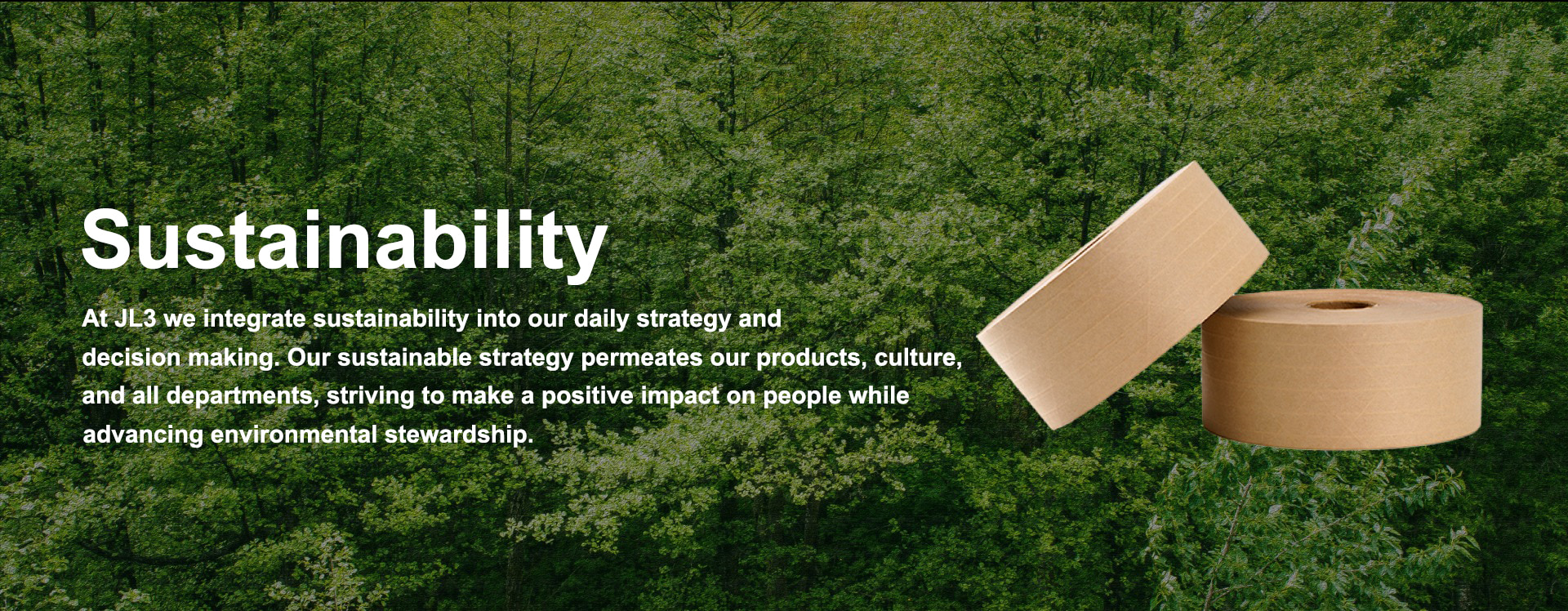
If the carton is packed at your own bench, with water and a dispenser, water-activated kraft tape is a strong choice for a sealed export carton. Its starch adhesive wets into the board fibres and forms a bonded layer with the carton itself. There is no film edge to lift, opening it tears fibres so tampering shows, and it is plastic-free and recyclable with the carton — which matters for the EU under the Packaging and Packaging Waste Regulation, where JL3 tapes were tested in 2026 with PFAS not detected.
The rule in one line: no water station at the packing point means self-adhesive kraft tape — water-activated tape is only an option where water and a dispenser are actually in place.
But most export cartons are not packed at your own bench. They are packed at a supplier, a field site, or a third-party point with no water station and no dispenser. Specifying water-activated tape there is a plan that will not be — and a plan that is not is worse than a simpler plan that is. For those points, default to self-adhesive kraft tape: hot-melt, pressure-sensitive, sticks on contact, typically rated about -5°C to 60°C, about one year of roll shelf life against about two years for water-activated tape. You give up some tamper-evidence strength. You gain a seal that actually gets applied, properly, every time. That trade is worth making, and it should be written down so every packer makes the same choice instead of improvising.
| Carton weight | Water-activated kraft grade |
|---|---|
| Up to 10 lb | JLN-370 / JLN-382 |
| 10–35 lb | JLN-3140 / JLN-3150 |
| 35–55 lb | JLN-3160 / JLN-3750 |
| 55–90 lb | JLN-3780 |
| Over 90 lb | JLN-37120 / JLN-37120R (reinforced) |
Whichever family you use, the pattern is the same, and it is not optional for export. H-seal: centre seam plus both ends, with at least two inches of overlap onto each side panel. Short overlaps are the first thing to lift in transit, and end strips are what stop flap lift when a carton is dragged or dropped. Over 55 lb, or where the contents are dense, sharp-edged, or valuable enough that a split seam becomes a claim, step the grade up and add reinforced end strips. Over 90 lb, add filament strapping around the carton. Tape seals the carton. Strapping carries the load. Confusing the two is how export seams fail.
A few bench habits matter as much as the grade. Seal only dry cartons — a seal laid on damp board starts weak and never recovers. Let a water-activated bond set before the next carton goes on top, or the bond gets sheared while it is still forming. And photograph the sealed carton at dispatch. A photo settles most arrival disputes in one message: the seal either arrived as photographed, or it did not.
One more trade to be honest about: a tamper-evident seal that tears fibres is excellent for a carton that should stay closed, and a bad choice for a carton that will be opened and resealed at destination. If the destination needs to open and reseal, say so up front and choose accordingly, rather than discovering it when a receiver has to cut a fibre-bonded seal apart.
JL3 supplies export sealing as a matched set — water-activated kraft and reinforced tapes by carton weight, self-adhesive kraft for no-water-station packing points, tamper-evident seals, filament strapping for heavy loads, and manual and electric dispensers for export packing benches — contact us through the inquiry form with your destination markets, carton weights, transit time and packing points, and we will specify the seal with you.
Tape performance values are laboratory averages; test on your own cartons before committing.




 IPv6 network supported